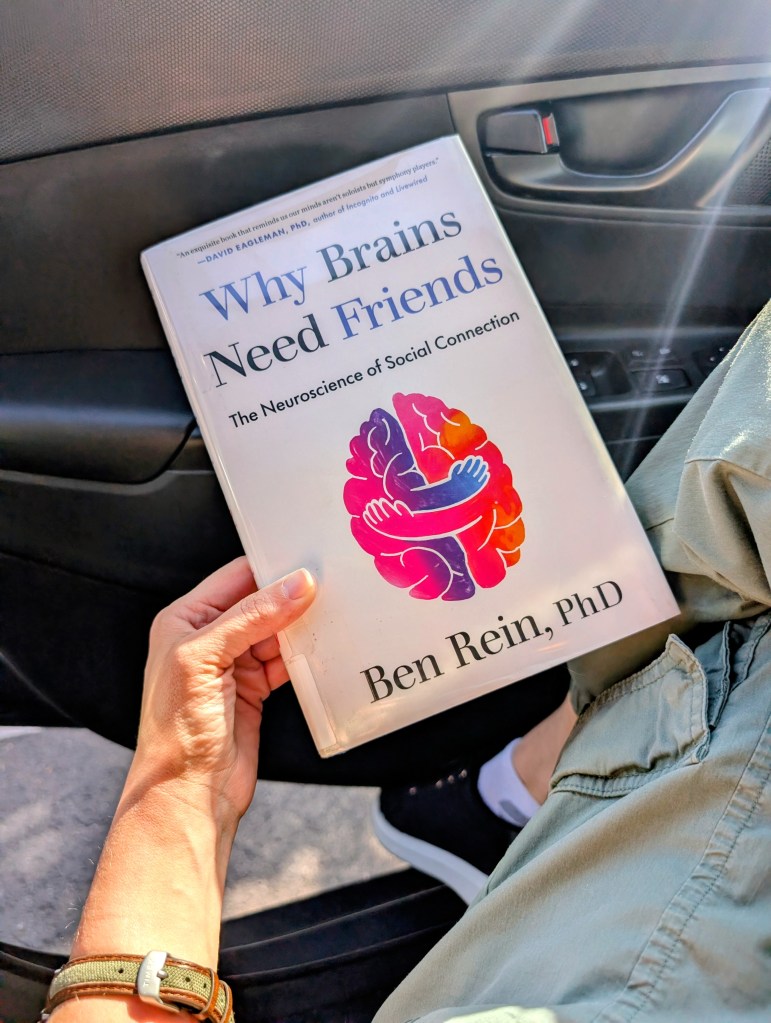
05/02/2026 Today, I finished reading “Why Brains Need Friends” written by Ben Rein. Brains need friends… you do not need to read a book to know that. However, if you want insight into neuroscience research and what happens in the brain on a chemical level, then this book offers insight. I knew mice were used for research, but I do not think I had ever given consideration as to why. I had never given mice credit for empathy, generosity, or taking on the pain of those hurting around them. As an avid (often solo) walker, I have taken note of the way animals are often found in pairs or groups (e.g., dolphins, seals, ducks, birds, fish, turtles, etc.). Animals may be modeling connection while humas navigate paths of disconnection. Unsurprisingly, pets can add value to a person’s life. I thought it was interesting to reflect on emojis and the contrast between texts with and without (e.g., hey vs. hey 🙂 …). There are many avenues to communicate today (text – call – video call/conference) and none of them are a true replacement for in-person connection. Overall, this was an easy and informative read. For lonely souls, this book is not a solution to overcoming loneliness. I always equate it to telling an anorexic person they just need to eat more; telling a chronically lonely person, you just need to connect more … is actually NOT helpful. This book will tell you – connect more, lol.
Quote(s) for Reflection:
- “There are loads of other species that do share our drive to be social, because they survive best in groups. Monkeys travel in troops, fish swim in schools, dogs hunt in packs, and even mice live in colonies.”
- “Each person’s unique social preferences really do reflect differences in how their brain functions.”
- “Your loneliness may literally be altering your brain function in ways that make it difficult for you to find meaningful connection.”
- “Emotions can be contagious passing between people through observation and mimicry of social cues.”
- “… animals (e.g., zebra fish, elephants) experience empathy and compassion. Like us, they are complex beings. They can understand others’ emotions and adapt their beliefs in changing circumstances.” (note: caution was given on overgeneralization to all animals, e.g., chickens did not show concern for other adult chickens, but they did do so to their chicks)
- “Pity, sympathy, empathy, and compassion are distinct. Pity involves the least emotional concern, while compassion involves the most.”
- “Mice have been shown to take on one another’s pain.”
- “The first e-mail was sent in 1971.”
- “We can’t equate virtual interactions to in-person ones” (leaves out important social cues that enrich connection and does not thrill the brain in the same way)
 Simply Op
Leave a comment