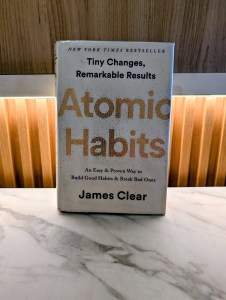
01/03/2026 Today, I finished reading the book “Atomic Habits” written by James Clear. I have come across this book title on a multitude of must-read lists. With onset of a New Year, it seemed like the perfect time to actually read it. One of the first things the author does, unsurprisingly, is define Habit. He defined habit as a, “… routine or behavior that is performed regularly, and in many cases, automatically.” The author prompts the reader to intentionally think about his/her own habits and to determine if they are good, bad, or neutral. As a person who enjoys self-reflection, analysis, and improvement, I appreciated this prompt. The author explains the four laws of behavior change that may be utilized to build better habits. The following key words were emphasized to encourage effortless behaviors: obvious, attractive, easy, and satisfying. Invisible, unattractive, hard, and unsatisfying were emphasized as ways to make a behavior more difficult. Examples, strategies, and fill-in-the-blank formulas are included throughout the book for support. Overall, I enjoyed reading this book and I look forward to further reflection on the following quotes:
– “Improving by 1 percent isn’t particularly notable, sometimes it isn’t even noticeable, but it can be far more meaningful especially in the long run. The difference a tiny improvement can make over time is astounding.”
– “Your identity is literally your ‘repeated beingness.’ Whatever your identity is right now, you only believe it because you have proof of it. If you go to church every Sunday for twenty years, you have evidence that you are religious. If you study biology for one hour every night, you have evidence that you are studious. If you go to the gym even when it’s snowing, you have evidence that you are committed to fitness. The more evidence you have for a belief the more strongly you will believe it.”
– “The effect of one-off experiences tends to fade away while the effect of habits gets reinforced with time, which means your habits contribute most of the evidence that shapes your identity. In this way, the process of building habits is actually the process of becoming yourself.”
– “The brain is continually scanning the environment, predicting what will happen next, trying out different responses, and learning from the results. The entire process in completed in a split second, and we use it again and again without realizing everything that has been packed into the previous moment.”
– “The ultimate purpose of habits is to solve the problems of life with as little energy and effort as possible.”
– “Any habit can be broken down into a feedback loop that involves for steps: cue, craving, response, and reward.”
– “The human body has eleven million sensory receptors. Approximately ten million of those are dedicated to sight … visual cues are the greatest catalyst of our behavior. For this reason, a small change in what you see can be a big shift in what you do.”
– “Be the designer of your world and not merely the consumer of it.”
– “To put it bluntly, I have never seen someone consistently stick to positive habits in a negative environment.”
– “Bundled together, your unique cluster of genetic traits predispose you to a particular personality. Your personality is the set of characteristics that is consistent from situation to situation.”
– “Until you work as hard as those you admire, don’t explain away their success as luck.”
– “If you only do the work when it’s convenient or exciting, then you’ll never be consistent enough to achieve remarkable results.”
Final Thoughts: Post analysis, I have established quite a few good habits, but my daily latte intake ($$) may be questionable. I have been reflecting on my own examples of achievement over time. One example may be visiting over 200+ CA coffee shops. I did not visit over 200 CA coffee shops in one day, but over years of consistent weekly ventures. Another example would be teammate of the year. I did not earn teammate of the year in 2024 because I cared for one day or did anything outstanding, but because I made a consistent effort to care every day that I was present at work. When I had used a Fitbit, I was eventually awarded for walking 1,000s of miles; in reality, I had just walked 2-miles or less per day. Interestingly enough, when my coffee ventures started to wane, I started to have a harder time finding purpose. The ventures waned because the shops I had not yet visited were made more difficult by a longer distance factor (aka., my habit declined because driving further in CA traffic was less satisfying). Something that had been very habitual for me and part of my identity was less prominent. I usually start the year strong with the habit of journaling, but by 6-months in or so, journaling sometimes feels more like a chore than something I truly enjoy. Clearly, I have just begun to apply the teachings and process what I have recently learned about habits. In the meantime, I hope you have enjoyed this review. #1PercentBetter
 Simply Op
Leave a comment